[Direct link to RTO Insider article (has a paywall): https://www.rtoinsider.com/132100-ferc-chair-swett-questions-whether-pjm-too-big/
FERC Chair Swett Questions Whether PJM is Too Big
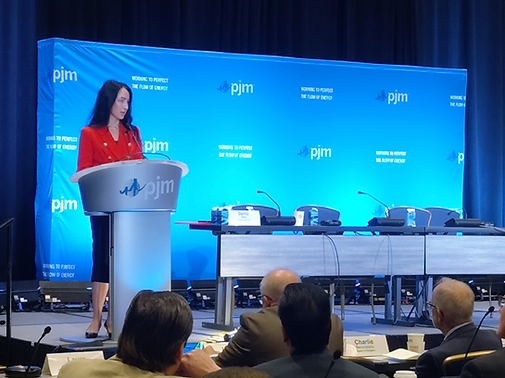
FERC Chair Laura Swett speaks at the PJM Annual Meeting. | © RTO Insider
May 12, 2026 | Devin Leith-Yessian
FERC Chair Laura Swett questioned whether the diversity of priorities across PJM's 14 member jurisdictions and 1,000-plus stakeholders makes it too large to act decisively.
BALTIMORE — FERC Chair Laura Swett announced the commission will hold a technical conference in July to identify the source of deadlocks in PJM’s stakeholder process and questioned whether the diversity of priorities across its 14 member jurisdictions and 1,000-plus stakeholders makes it too large to act decisively.
Why This Matters
Swett's comments about PJM's governance and her announcement of a FERC-led technical conference come as the RTO has faced heavy criticism over its stakeholder process, especially from state governors.
Speaking at the RTO’s Annual Meeting on May 12, Swett said the “stakeholder process is too slow where it must be fast, opaque where it must be transparent” and is vulnerable to vetoes when action is needed. She quoted language from PJM’s manual detailing the stakeholder process and argued the RTO is missing its objective of balancing consensus and acting when needed. She said any organization that has survived a century, as PJM has, must know how to evolve.
“Governance cannot be orthodoxy,” she said.
Swett said there’s a crisis of confidence in PJM, and she can’t blame one of the largest utilities for weighing leaving the RTO. A week prior to the meeting, American Electric Power CEO Bill Fehrman said the company had identified issues with the efficiency of bringing new load online in PJM and SPP and is “assessing all of our options” during the company’s first-quarter earnings call. (See AEP Evaluating its Membership in PJM, SPP.)
PJM needs new generation, Swett said, and companies already have stated they are willing to pay their fair share to cover their load. There is no appetite to undermine investor confidence by allowing changes that would disrupt existing agreements, she added.
The conference will open on July 23 “with a particular focus on identifying and evaluating actionable reforms to improve PJM’s ability to address system needs in a timely and efficient manner,” according to the commission’s announcement.
PJM responded with a written statement: “PJM appreciates FERC Chair Swett’s interest in the PJM stakeholder process and the expectations for its success. We look forward to participating in the upcoming technical conference and continuing our work to strengthen grid reliability including advancing the reliability backstop auction efforts to bring new generation online as quickly as possible.”
Maryland Del. Lorig Charkoudian (D) told RTO Insider she’s cautiously optimistic about the possibility of FERC-led governance reform at PJM. Her focus is on creating a role for states in the stakeholder process, which could take the form of member states having filing rights equal to the RTO’s membership, as in ISO-NE, she said.
Charkoudian argued that large utilities and power providers hold outsized power in the stakeholder process and is skeptical of the argument that a divide between PJM states is driving inaction. She noted Pennsylvania Gov. Josh Shapiro (D), Maryland Gov. Wes Moore (D) and former Virginia Gov. Glenn Youngkin (R) each called for governance reform and were involved in the creation of the PJM Governors’ Collaborative. While the states have called for a more proactive role in the RTO for years, it is only recently that this idea has gained ground as reliability and affordability have been challenged by data center load. Had PJM taken legislators’ priorities to heart and addressed barriers to bringing renewables and storage to the grid, there would be more capacity available, she said.
Paul Sotkiewicz, president of E-Cubed Policy Associates, said he viewed Swett’s comments as a threat to PJM and its stakeholders to get their act together, or the commission will force changes on it.
“The air went out of the room when she announced it. No one saw it coming … and the fact that she did that and then ended her speech and walked out the door spoke volumes. To me, what that signaled was, ‘I told you what I need to tell you; I’m not going to have a discussion with anyone right now,’” he said.
Though the goal may be to assert an illusion of control over the ability to bring more generation online, Sotkiewicz said he expects that shaking up PJM decision-making will have the opposite effect. Investors may be cautious about supporting the sort of large, expensive projects needed and opt to wait until there is more clarity over PJM’s future. He said the commission could have chosen to open a Federal Power Act Section 206 proceeding on the stakeholder process or capacity market, but that such an act could be the final nail in coffin to investor confidence in PJM’s direction. Moreover, there are shortages of the transformers, turbines and specialized labor needed, which inhibit development and are outside both PJM and FERC’s control, he said.
Several stakeholders speaking to RTO Insider at the meeting speculated that the commission may seek to shift filing rights over the energy and ancillary service markets from the Operating Agreement to the tariff, which would grant PJM’s Board of Managers unilateral filing rights.
Sotkiewicz said he would have sympathy for a desire at the commission to shift the energy and ancillary markets to the tariff, as it would allow PJM to act more decisively, but members would be loath to give up their FPA Section 205 filing rights over those markets, setting up an ugly battle. If the commissioners wanted PJM to make specific changes, they could encourage it to hold pre-filing meetings with stakeholders, he said.
Ari Peskoe, director of Harvard’s Electricity Law Initiative, wrote in an email to RTO Insider that RTO governance and filing rights fall under the commission’s purview.
“The D.C. Circuit [Court of Appeals] has provided two guardrails on these issues: 1) FERC may not fire individual RTO board members, and 2) FERC may not require utilities to cede their Section 205 filing privileges. Since the Members Committee is not a public utility under the FPA, neither limit would apply,” he wrote.
On AEP’s statements that it is exploring leaving PJM, Peskoe said transmission owners may be seizing a moment of “widespread dissatisfaction with PJM” to revamp their effort to shift filing rights over the RTO’s planning protocols to the RTO itself, which the commission rejected in 2024 over concerns that it would grant transmission owners undue influence over PJM. (See FERC Rejects PJM and Transmission Owners’ CTOA Proposals.)
“I doubt that exit is viable for AEP, particularly in Ohio. But perhaps its real goal is to obtain greater control over PJM decision-making,” he said.
In a LinkedIn post May 12, former FERC Chair Mark Christie said PJM’s governance is flawed without a role for the states. He pointed to his concurrence in the commission’s December 2024 order rejecting the filing rights proposal, which he argued would undermine the RTO’s independence at the same time it is granted more authority.
“As a state regulator in PJM for 17 years, and then their federal regulator for several more years, I came to the conclusion that PJM’s governing structure is fatally flawed,” Christie wrote in the post. “The states have no substantive role whatsoever. That alone makes PJM’s governing structure untenable. PJM’s core problem is and always has been political, not economic or even regulatory. Until that is fixed, it will only get worse.”